
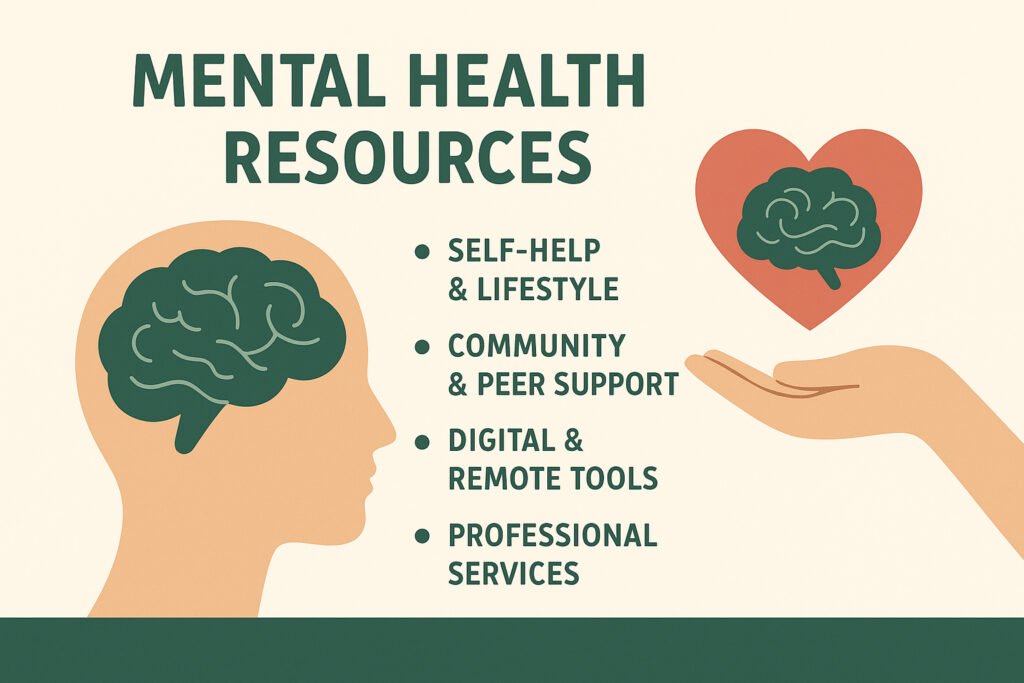
Mental Health Resources: A Guide for Health-Conscious Readers
Introduction
Mental health is an integral part of our overall well-being. Just as we focus on diet, exercise, rest, and preventative care for our physical well-being, it is equally important to take care of our mental and emotional health. But many people don’t know where to start, or how to find reliable sources of support during times of stress.
In this article, we will discuss—
- What are mental health resources?
- The different types (self-help, community, professional, digital, and crisis support)
- How to choose and use a resource
- Scientific research on the topic
- Practical advice for readers
________________________________________
What are mental health resources?
“Mental health resources” refer to any means, service, or support that helps maintain, improve, or restore mental well-being. It can be preventive, supportive, therapeutic, or crisis-related.
These resources can be seen as a continuum:
- Self-help/preventive measures
- Community and peer support
- Digital or online tools
- Professional services
- Crisis or emergency support
________________________________________
Types of mental health resources
- Self-help and lifestyle strategies
These are the first step for many and help maintain mental stability.
- Meditation, mindfulness, breathing exercises — reduce stress, help maintain focus
- Physical activity — walking, yoga, exercise improve mood
- Sleep hygiene — regular and adequate sleep is the key to mental balance
- Writing or journaling — helps clarify thoughts and feelings
- Mental health books or workbooks
- Nutritious foods and care for the gut-brain connection
- Creative media — singing, painting, closeness to nature, etc.
These are usually available at low cost or for free and can be incorporated into daily habits.
________________________________________
- Community and peer support
Connecting with others plays a big role in mental well-being.
- Support groups — Discussions about specific issues (e.g., anxiety, grief, addiction)
- Community centers or mental health organizations
- Religious or spiritual groups — Many people get mental health support from these groups
- Helplines or warm lines — Trained volunteers listen and offer advice
- NGOs or advocacy groups — such as NAMI (National Alliance on Mental Illness) in the United States provide education, support, and advocacy
These types of resources can reduce loneliness and provide guidance to professional help if needed.
________________________________________
- Digital and online resources
Technology has greatly expanded the field of mental health care.
- Mental health apps — mood trackers, CBT-based guides, meditation tools, etc.
- Online counseling / teletherapy — therapy services via video or phone
- Digital courses or self-help programs
- Chatbots or conversational agents — helpful in managing mild stress
- Podcasts, webinars, and blogs — sources of learning and awareness
While their benefits are many, it is important to choose after checking the quality and effectiveness.
________________________________________
- Professional services
If self-help or community support is not enough, professional treatment may be necessary.
- Psychotherapy / therapy — such as CBT, DBT, ACT, trauma therapy
- Psychiatric treatment and medication management
- Case management and care coordination
- Hospital-based or intensive care programs
- Neurostimulation therapy (ECT, TMS) — for treatment-resistant depression
________________________________________
- Crisis and emergency support
Immediate help is needed in serious or life-threatening situations.
- Suicide prevention helplines (e.g., 988, in the United States)
- Hospital emergency departments
- Crisis mobile teams
- Text or online crisis support
- Safety plans
Everyone should know in advance where and how to get help if needed.
________________________________________
Choosing and using mental health resources wisely
- Assess your needs — whether they are mild, moderate, or severe — and take appropriate action.
- Choose trusted sources — check the professionals’ licenses, experience, and evidence-based information.
- Use tiered strategies — such as meditation + support groups + therapy.
- Maintain consistency — one session is not enough; consistency is essential.
- Consider confidentiality and cost.
- Be flexible with your time.
- Track progress.
- Remove barriers to access.
________________________________________
Scientific evidence and research
Effectiveness of psychotherapy and combined approaches
- Numerous studies have shown that cognitive behavioral therapy (CBT) is effective for depression and anxiety.
- Therapy + medication often produces the best results.
- ECT or TMS has been shown to be effective in treatment-resistant cases.
Digital tools and e-mental health
- Research shows that internet-based CBT (i-CBT) can be as effective as face-to-face therapy in many cases.
- Mobile apps and chatbots have opened up new avenues for psychological support, although more research is needed.
Peer and community-based initiatives
- Peer support groups increase emotional connection and aid recovery.
- Community educational programs can help reduce relapse rates
Lifestyle and Complementary Approaches
- Physical exercise is scientifically proven to reduce depression and anxiety.
- Mindfulness-Based Stress Reduction (MBSR) is effective in managing stress.
- Sleep, nutrition, and integrated mind-body care enhance mental well-being.
Limitations and Future Directions
- Cost, stigma, and lack of services are major barriers.
- The quality of digital tools is uneven.
- Multidimensional and long-term research is needed.
- Person-centered mental health care and digital-hybrid models will play a major role in the future.
________________________________________
Practical advice for readers
- Create your own mental health map — include self-help + community + professional support.
- Start slowly, build up slowly.
- Note progress.
- Change what’s not working.
- Talk openly about mental health.
- Seek professional advice if needed.