
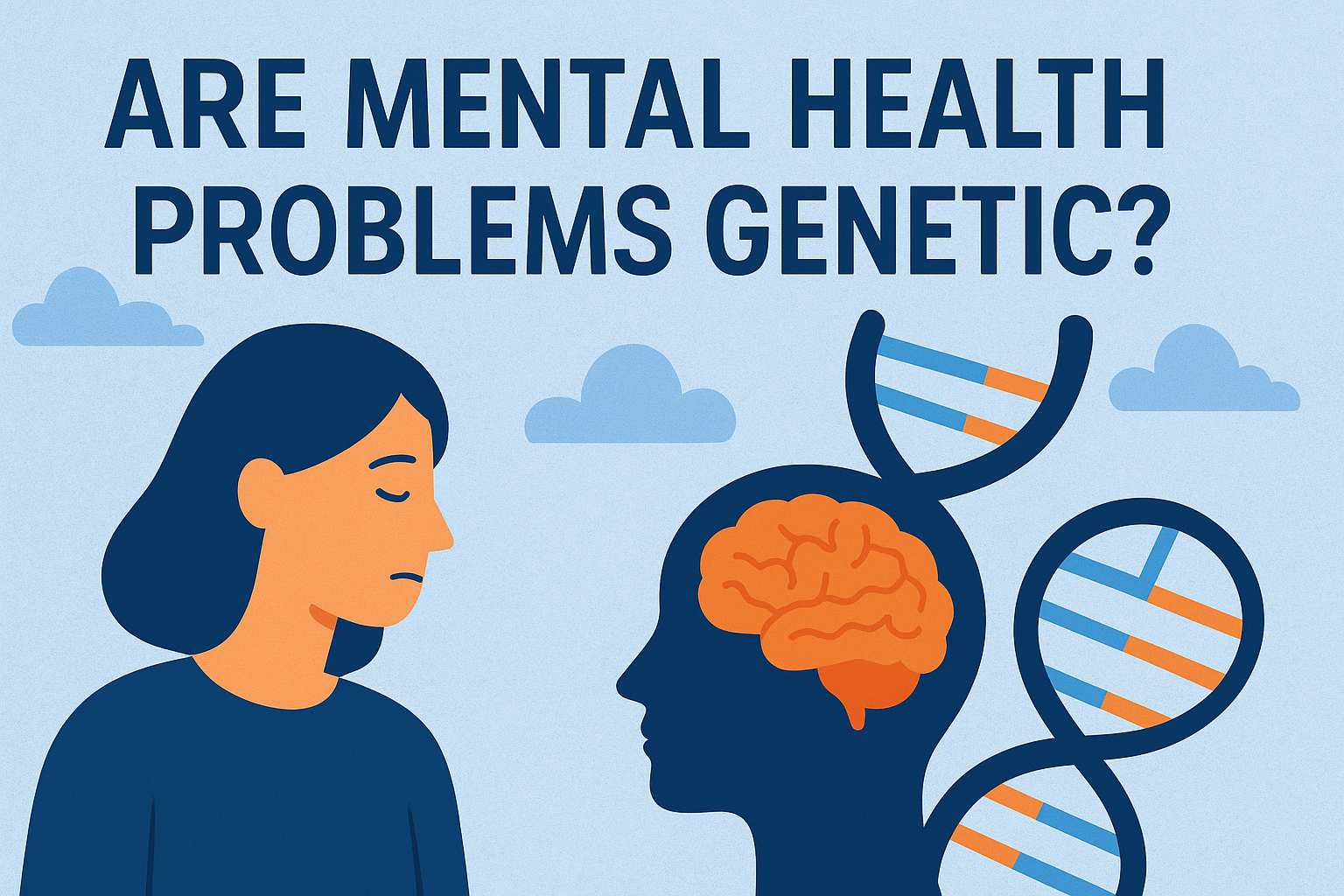
Are mental health problems genetic?
Depression, anxiety, bipolar disorder, schizophrenia, or PTSD — these mental health problems raise an important question: How much of the risk comes from our genes, and how much from our environment and life experiences?
The short answer is: Genetic factors are important, but they don’t explain the whole picture.
Below, we’ll explain the science, how researchers measure genetic influences, what the latest research says, and what practical implications they have.
What does “genetic” mean in mental health?
When researchers say “a problem is genetic,” they usually mean that no single gene is the cause of the problem. Most mental illnesses are polygenic — meaning that thousands of genes have small effects that work together to increase risk.
Some rare mutations can cause certain neurodevelopmental disorders, but these are very limited for common mental disorders.
The two main ways to understand genetic influences are:
• Family and twin studies: Estimate the “heritability,” or amount of genetic influence, by comparing monozygotic (identical) and dizygotic (fraternal) twins.
• Genome-wide association studies (GWAS): Analyze the genes of millions of people to find out which gene variants increase risk.
Key research evidence
- Family and twin studies: Strong genetic evidence
These studies show that the heritability of many mental illnesses is clear — the heritability of schizophrenia and bipolar disorder is typically around 60–80%. For depression and anxiety, it is moderate (around 30–50%).
This shows that the risk is slightly increased if someone in the family has the condition. - GWAS: Many small genetic effects work together
Over the past decade, large-scale GWAS have shown that hundreds of gene variants are associated with mental illness, but each has a very small effect. Taken together, they can explain only a fraction of the total risk. - Rare mutations
Some forms of autism, some intellectual disabilities, or early-onset schizophrenia sometimes involve a single rare gene defect — although these are very uncommon. - Gene–environment interactions
Genes increase risk, but the environment often determines whether the risk actually becomes a problem.
Childhood trauma, chronic stress, malnutrition, pregnancy complications, and social discrimination can increase or decrease the effect of genes.
Recent research suggests that the environment can also change the “expression,” or activity, of our genes (epigenetics).
A brief overview of genetic influences in various mental disorders
• Schizophrenia: One of the most genetically influenced mental disorders (about 60–80%). Hundreds of gene signals have been found in GWAS.
• Bipolar disorder: Very high heritability, with some genetic similarities to schizophrenia.
• Major depression: Moderate genetic influence (30–40%). Recent large global studies have found many more new gene signals.
• Anxiety disorders: Different subtypes have different heritabilities, usually moderate.
• PTSD: This is complicated by the mandatory experience of trauma — but research has shown that there is a genetic influence.
Key updates from recent scientific research
- Larger and more diverse GWAS
A study from 2024–2025 found new genetic signals for depression, schizophrenia, etc. in a large multi-ethnic dataset. This is making the biological pathway of the disease clearer. - The effect of the same gene on multiple mental illnesses
Studies have shown that many gene variants play a role in the risk of depression, anxiety, bipolar disorder, or schizophrenia at the same time. This explains the co-occurrence (comorbidity) of many diseases. - Epigenetics
The long-term impact of stress, toxins, viral infections, etc. on mental health by changing the activity of genes in the body is now clearer in research. - Limited clinical use but potential
Polygenic risk scores (PRS) are not yet widely used in medical diagnosis because they only explain part of the risk. However, in the future, they may be useful in risk identification or treatment response prediction.
Its practical aspects — for both individuals and medicine
• Genetic risk does not mean a definite illness. Lifestyle, environment, therapy, medication, and social support can greatly reduce the risk.
• Family history is important. Doctors use it to assess risk, but it must be combined with other environmental factors.
• Understanding genetic causes reduces the tendency to view mental illness as a “fault” or “weakness.”
• Ethnic diversity is essential in research. Most genetic research still focuses on European populations — creating challenges to equality.
Conclusion
It is clear to science — genes play a role in mental health problems, but genes alone cannot explain everything.
Most mental illnesses are caused by a complex mix of small effects from many genes and environmental changes. As large global studies continue, genetic information may help to better identify treatments and risks in the future.